Start broad, then narrow
First decide whether warm families or cool families look easier. Then decide whether light or deep colors support you. After that, compare clear versus muted colors. The final season is the intersection, not a single clue.
Find my color season
Last updated: July 13, 2026
How to find my color season: compare undertone, depth, contrast, and chroma, then test real colors instead of trusting one quiz result.
How to find my color season is a practical question, not only a theory question. The right season should help you decide between black or brown, silver or gold, ash brown or copper hair, coral or berry lipstick, cream or optic white, and whether soft muted colors or clear bright colors make you look more awake.
Short answer
How to find my color season: compare undertone, depth, contrast, and chroma, then test real colors instead of trusting one quiz result.
First decide whether warm families or cool families look easier. Then decide whether light or deep colors support you. After that, compare clear versus muted colors. The final season is the intersection, not a single clue.
The most common mistakes are using indoor yellow light, judging from hair dye instead of natural contrast, assuming all Asian skin is warm, assuming pale skin is cool, and choosing favorite colors instead of face-flattering colors.
A season should reduce returns and hesitation. If a label does not help you choose clothes, hair, makeup, glasses, or jewelry, test the actual colors and let the visual result matter more than the name.
Before checkout
Do not treat "How to find my color season" as an order to rebuild your entire wardrobe at once. Pick one real decision first: two tops in your cart, two hair-color ideas, a wedding guest dress, daily glasses, or a lipstick shortlist. The more concrete the purchase, the easier the result is to judge. A color that is theoretically flattering but never worn, bought, or placed near your face does not matter for the current decision.
Photo-based testing works best when you reduce variables. Use the same daylight front-facing portrait, the same makeup level, the same screen brightness, and compare colors within one category: light against light, deep against deep, cool against warm, clear against muted. That makes it easier to see what the color does to facial clarity, shadows, redness, and feature definition instead of reacting to pose, expression, or camera angle.
Color analysis has the highest impact near the face: tops, collars, scarves, coats, hair color, glasses, earrings, necklaces, and lipstick. If a color is difficult near your face, that does not mean it has to disappear from your life. Use it in pants, shoes, bags, belts, nails, or small prints. This keeps personal taste in the wardrobe while reducing the purchases most likely to make you look dull or tired.
A human stylist is still valuable for bridal styling, expensive wardrobe rebuilds, complex salon color, custom frames, or cases where you keep landing between two seasons. The AI report is meant to narrow direction quickly, create visual references, and reduce uncertainty before checkout. It is not a medical skin judgment, certified fabric draping session, or professional dye formula. Use it as a shopping screen, not an unbreakable rule.
After the test, do not only save the season label. Write down the three to five colors that looked most useful, the three colors most likely to cause mistakes, the neutrals that work near your face, the colors better used as accents, and the result of one real purchase. Review that note after two weeks, when the novelty has worn off. If a suggested color looks good in try-on photos, mirror checks, and a normal day out, it deserves a place on your default shopping list. If it only looks good on screen but still feels dull in real life, downgrade it to a small far-from-face accent.
Finally, compare the result with clothes you already own. Pull three pieces that reliably get compliments and three pieces that never feel right even though you like them on the hanger. Look at their warmth, depth, contrast, and softness. Often the strongest evidence is already in your closet; it simply has not been organized into a rule. The report should turn scattered hunches into repeatable buying filters, not pressure you to replace everything at once.
If one photo result contradicts years of real-life experience, retest with a cleaner daylight photo before changing your rules. Shadows, smoothing, filters, overexposure, heavy makeup, and dyed hair can all exaggerate errors. A recommendation is worth trusting when it appears consistently across several ordinary photos and one real purchase.
Comparison table
| Question | If yes | Likely direction |
|---|---|---|
| Do light warm colors look fresh? | Peach, light aqua, ivory feel easy | Light Spring |
| Do golden warm colors look healthy? | Camel, coral, warm green feel natural | Warm Spring or Warm Autumn |
| Do bright colors look clear, not loud? | Hot coral, cobalt, emerald sharpen the face | Bright Spring or Bright Winter |
| Do cool soft colors look calm? | Dusty rose, lavender, blue-gray feel easy | Light/True/Soft Summer |
| Do muted warm colors look expensive? | Moss, taupe, terracotta, olive feel grounded | Soft/Warm Autumn |
| Do deep colors sharpen your face? | Espresso, black, burgundy, pine add clarity | Deep Autumn or Deep Winter |
Decision steps
Test your colors now
Upload a front-facing portrait and choose six colors first. The free result gives undertone, contrast, and a starter palette; if the direction is useful, unlock the full report with the same photo and palette.
Method
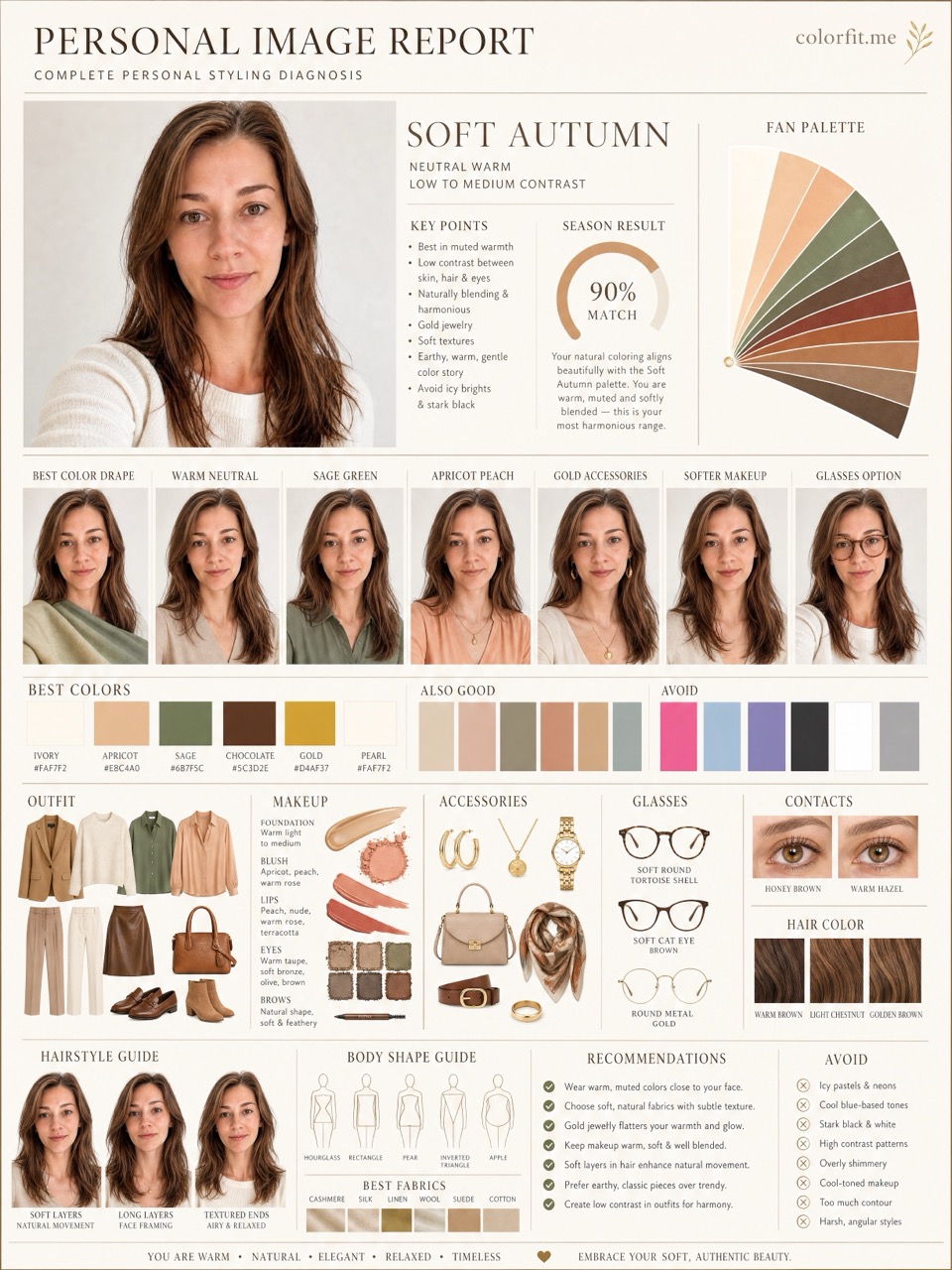
The report uses the uploaded portrait, six selected test colors, delivery language, and package type. It does not stop at a seasonal label; it turns the direction into visual boards for clothes, hair color, makeup, glasses, and accessories.
| Step | User input | Output |
|---|---|---|
| Free preview | Photo + six colors | Undertone, contrast, and limited direction |
| Mini report | Paid order + same portrait | Two core visual boards |
| Full report | Paid order + photo + selected colors | Eight boards across image, color, and styling decisions |
Questions
Your natural coloring changes slowly, but hair dye, tanning, gray hair, and personal style can change what feels easiest.
No. You only need enough contrast to choose better colors. Many people only need to separate two or three likely seasons.
Season systems are guides. Some colors work because of styling, makeup, contrast, fabric, or because they are near a border season.
No. Use them away from the face, as accessories, or with balancing makeup if you still like them.
Ready when you are